

The pace of cloud evolution today, is the fastest we have ever experienced, yet, it is the slowest moving forward. Many clients are shifting from experimentation phase to full speed ahead cloud adoption and they are already scanning the horizon to see what is next.
So what is the forecast for cloud?
Figure 1 highlights many areas that will evolve in the near future which I will briefly describe each. To clarify, my view on “Cloud Future” is based on 3-5 years’ time frame.
Hybrid Architecture
New business requirements are driving the adoption of Hybrid Cloud Architecture. For example, in financial services, banks are preparing for Fundamental Review of the Trading Block (FRTB) which goes live in 2021. From a technology prospective, FRTB requires massive computational power which most organisations do not have in their in on-premise data centre today. As a result, many clients are adopting hybrid cloud where they can spin up risk grids in the public cloud to do different types of risk calculations. This hybrid architecture will help clients meet the FRTB aggressive timelines and avoid massive upfront capital investment.
Multi-Cloud Architecture
Organisations with mature cloud presence, are starting to adopt multi-cloud architecture. What is driving this trend?
Many want to mitigate against the risk of putting all eggs in one basket. Others want the ability to mix and match vendors platforms/services to different workloads to avoid vendor lock-in and to take advantage of different pricing tiers by different vendors.
AI/ML
Artificial Intelligence (AI) and Machine learning (ML) will become an integral component built into intelligent cloud native applications. Smart Chatbots, Virtual Assistant, ecommerce recommendation engine are a few example of future intelligent applications built in the cloud.
SaaS
SaaS is becoming very main stream with many enterprise clients replacing their ERP with SaaS equivalent. That is why ERP license sales have been in decline while SaaS sales have built momentum.
IoT/Edge
IoT devices are ballooning in numbers and as a result, massive volumes of data is being sent to a local edge compute to collects and process. The benefit of edge computing, is near real time processing and efficient network utilisation. The data is sent afterwards to cloud for analytics.
The cloud will continue to be the main platform for AI development and analysis, however, AI applications will be developed and pushed to the edge to enable quick near real time prediction/analysis when needed.
Blockchain
Blockchain is a distributed secure digital ledger that records financial transactions, as well as anything of value. There are many use cases, starting with most known one, Crypto Currencies. Other use cases include, electronic voting, official records keeping, supply chain tracking & monitoring, anti-money laundering and Know Yours Customer (KYC) practices. Blockchain is going to be one of the fastest growing areas enabled by cloud.
API Economy
APIs are being elevated from being considered as a development tool to being a source for revenue generating business opportunities. The cloud provides turn-key API solutions to simplify API strategy execution.
Serverless Computing
There is a growing trend in adopting serverless technology. The reason is, the serverless platform automatically allocates compute, memory and storage based on resource requests placed on an application. This is a higher level of abstraction than those offered by virtual machines and containers. The benefit is what is called NoOps IT. This will result in minimal operations demands, better cost optimisation and faster time to market.
Quantum Computing
Quantum Computing is a technology that will leap into a mainstream in the not so distant future. However, this is an area of future technology where organisations need to become early adopters of. The reason is Quantum Computing is double edge sword. It offers massive computational power to create new business opportunities, but by the same token, hackers can also harness that same power to crack encryptions faster. As for anticipated use cases, in the financial services for example, Quantum Encryption and security, High Frequency Trading (HFT), Risks Analysis and portfolio optimisation are some examples.
Big Data
With the explosion of IoT and mobile devices, massive quantities of data is being produced. In the past, these large sets of data resided on-premise data centers. However, now with cloud based platforms, Big Data clusters are being deployed into the cloud to take advantage of scale and cloud economics.
XaaS
Anything as a Service (XaaS) is an umbrella that covers more than (IaaS, PaaS and SaaS) offerings. A few examples of emerging new XaaS offerings include Data as a Service (DaaS), Malware as a Service (MaaS), Backup as a Service (BaaS), and Disaster Recover as a Service (DRaaS).The benefits of cloud XaaS will accelerate its adoption by customers.
Cloud First
Yesterday’s virtualisation first strategy has been replaced today with cloud first strategy. However, the future will see cloud first strategy taken to extreme with many organisations closing their data centers and moving wholesale to the cloud.
Immersive Technology
Augmented Reality (AR), Virtual Reality (VR) and Mixed Reality (MR) used to be considered just a novelty, but today, it is being elevated into a serious business tool. The growing list of mainstream uses cases includes product manuals, employee training, virtual assistant, warehouse management and payment systems.
DaaS
Desktop as a Service is a buzz phrase that burst into the scene a few years ago and faded away quietly. The main reason is virtual desktops infrastructure (VDI) need to live close to the data. Now with most organisation data in the cloud, Desktop as a Service is a feasible attractive option that many will adopt. Those who wish to keep their VDI on premise, will utilise management and data control plain in the cloud to manage on-premise VDI sessions.
Automation
Cloud Automation is already used to manage complexities. Configuration management tools such as Chef, Puppet, Ansible and Salt are used to manage complex systems while tools like Terraform are used to reduce complexities of provisioning.
However, future enterprise platforms will grow even more complex with a combination of bare metal, virtual machines, containers, running on IaaS, PaaS and SaaS platforms in a Hybrid/Multi Cloud architecture. Areas such as security, compliance and monitoring will add to complexity.
Anything as a Code (Infrastructure as a Code, Security as a Code, etc.) will become mainstream to managing operations at such scale and complexity.
Legacy Systems
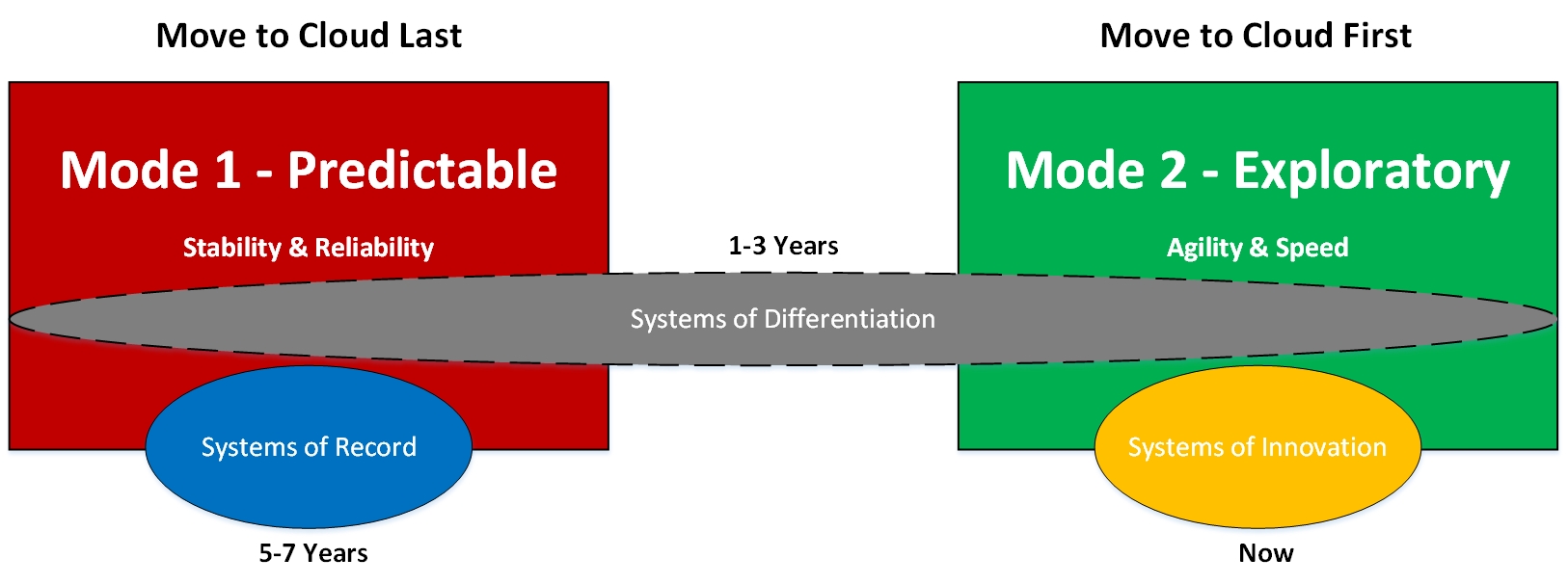
Today, many clients are adopting application pace layering to identify application that need fast release cycle and pair it with Bimodal approach for delivery (Figure 2) to meet different business requirements.
Systems of Innovation: These include email, social media, prototype apps, etc. These systems were the first to be deployed in cloud as they were low risk and innovative in nature. These tend to be Mode Two.
Systems of Differentiation: These include systems tend to provide industry specific capabilities. Examples include CRM, account management, help desk, etc. Many organisations have started shifting these systems to the cloud. These systems tend to sit in the middle between mode one and mode two.
Systems of Record: these are the mission critical core legacy systems that support the organisation. As part of digital transformation, these core systems will be target for migration to cloud in the next 5 to 7 years and will be replaced with cloud native architecture applications.
Full Cloud exploitation requires more than just technology
People
Preparing for future cloud has a bigger scope than just technology. People is a required ingredient for success. For example, most DBAs have SQL and relational database as main skills. However, the cloud is moving toward new data types such as Nuptune, DynamoDB, Kinesis, CosmosDB, NOSQL, Hadoop and many others. To successfully adopt these technologies, ogranisations will need to continuously elevate the skillset of their employees and map training path to their new roles.
Operations
The evolving cloud will impact security, architecture, operations and other areas covered by cloud governance that will need constant revaluation.
Summary
The future of cloud holds many new opportunities and a few new risks. Organisation will constantly need to adapt their strategies to harness the benefits of future cloud capabilities while mitigating against future risks.
I hope you have found the post informative and thank you for reading.
Nick

S Phillip
July 27, 2019Interesting vision of the future. I agree that it is impossible to predict anything beyond 5 years when it comes to cloud.
Consulting Jim
July 27, 2019What is your view of the future of consulting cloud services?